

Blog, City Guides
How to Prepare for HYROX Boston 2026: Race Info, Training Tips & Gear Guide
Jun
Last updated: September 28, 2026 — race dates and venues checked against hyrox.com.
HYROX is coming back to Boston, and if you’re registered — or thinking about it — this guide covers everything you need: race details, a realistic prep timeline, station-by-station training advice, and what to pack on race day.
Race dates: October 8–11, 2026 Venue: Boston Convention & Exhibition Center (BCEC), 415 Summer St, Boston, MA
Whether this is your first HYROX or you’re chasing a PR, use this guide to show up on the start line confident and ready.
What Is HYROX? (Quick Recap)
HYROX is a global fitness race that combines running and functional training into one standardized event. Every race — Boston included — follows the exact same format:
8 rounds of: 1 km run → 1 workout station
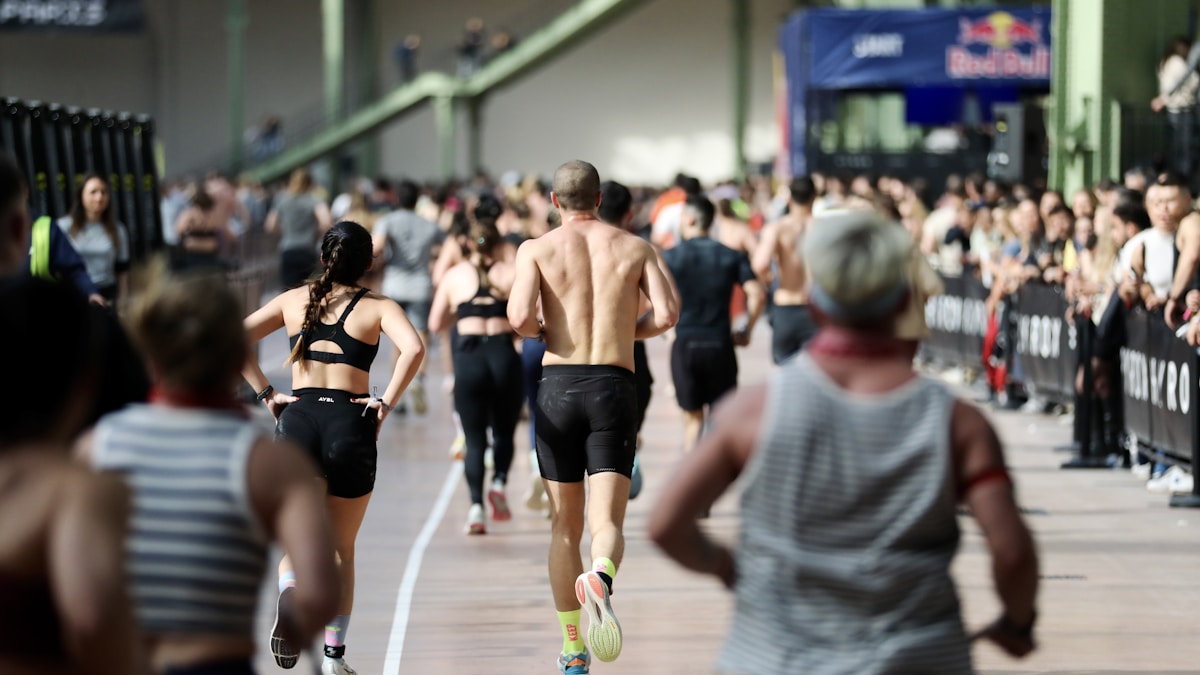
That’s 8 km of total running, plus 8 functional stations completed back-to-back. The order never changes:
| Station | Exercise | Distance / Reps |
|---|---|---|
| 1 | SkiErg | 1,000 m |
| 2 | Sled Push | 50 m |
| 3 | Sled Pull | 50 m |
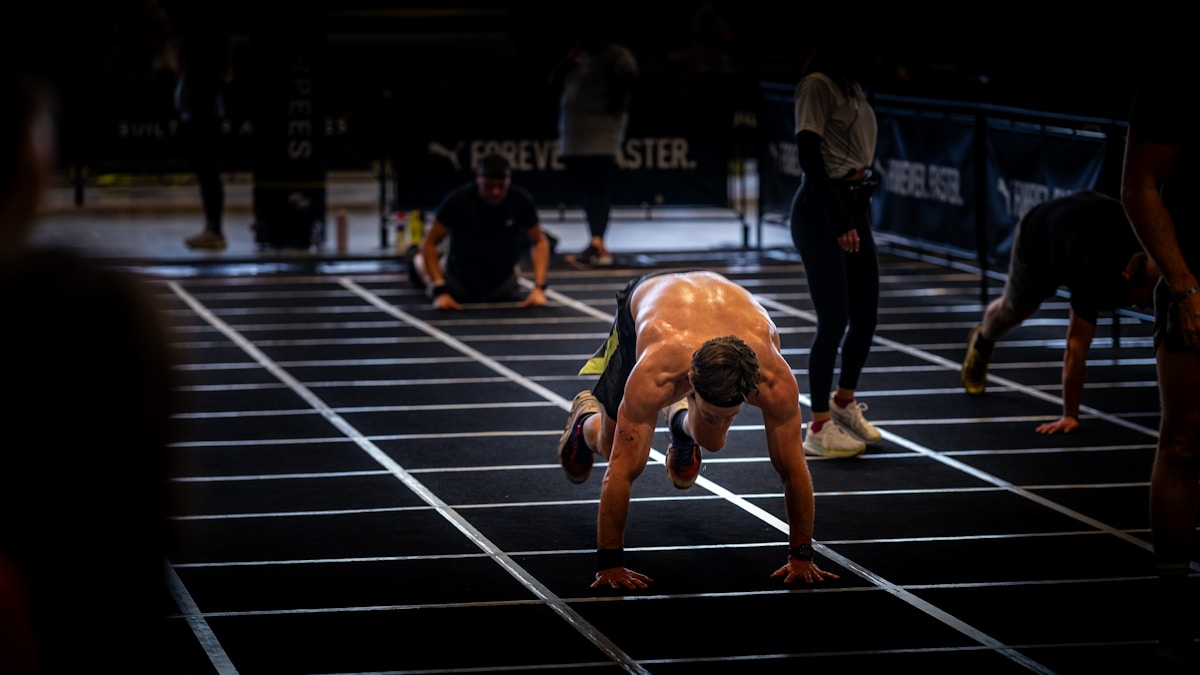
| 4 | Burpee Broad Jumps | 80 m |
| 5 | Rowing | 1,000 m |
| 6 | Farmers Carry | 200 m |
| 7 | Sandbag Lunges | 100 m |
| 8 | Wall Balls | 100 reps |
HYROX Boston 2026: Race Details
Dates & Venue
HYROX Boston 2026 runs October 8–11, 2026 at the Boston Convention & Exhibition Center (BCEC). The BCEC’s massive convention floor is a well-known HYROX venue format — all eight stations are set up indoors, so weather is never a factor.
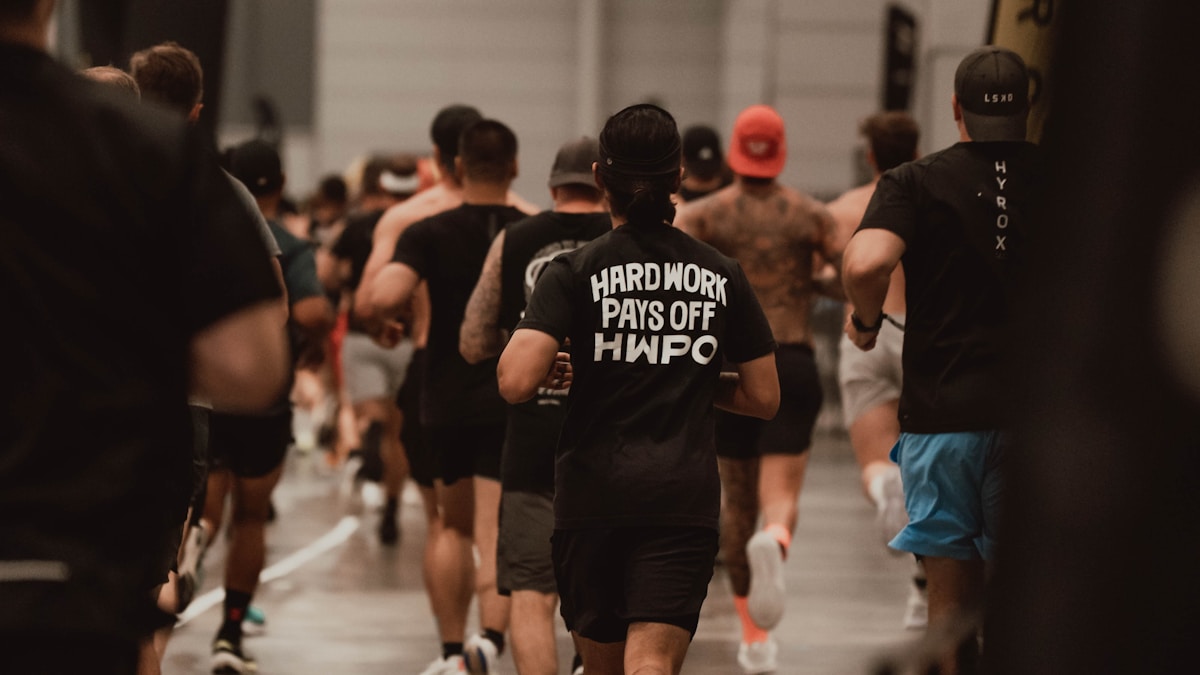
This year’s Boston event is co-presented with HWPO (Hannah Eden’s training brand), which has been a strong partner for several North American HYROX events.
Divisions
Boston 2026 offers every standard HYROX division:
- Open (Men / Women) — the most popular division; standard weights
- Pro (Men / Women) — heavier loads for experienced athletes
- Doubles (Men / Women / Mixed) — you and a partner alternate running and stations
- Pro Doubles — doubles format with Pro-level weights
- Relay (Men / Women / Mixed) — team of 4, each person completes 2 runs + 2 stations
- Adaptive (Men / Women) — inclusive division for athletes with physical impairments
Weights by Division
Open Men:
| Station | Weight |
|---|---|
| Sled Push | 152 kg (335 lb) |
| Sled Pull | 103 kg (227 lb) |
| Farmers Carry | 2 × 24 kg (2 × 53 lb) |
| Sandbag Lunges | 20 kg (44 lb) |
| Wall Balls | 6 kg (13 lb) to 10 ft target |
| Station | Weight |
|---|---|
| Sled Push | 102 kg (225 lb) |
| Sled Pull | 78 kg (172 lb) |
| Farmers Carry | 2 × 16 kg (2 × 35 lb) |
| Sandbag Lunges | 10 kg (22 lb) |
| Wall Balls | 4 kg (9 lb) to 9 ft target |
Registration & Check-In
Register through the official HYROX website at hyrox.com. On-site check-in requires a valid government-issued ID. You cannot check in on behalf of another athlete.
Boston-Specific Race Day Schedule (Sunday, Oct 11)
Start waves run across multiple days. Based on the published Sunday schedule:
- 08:00–10:40 — Doubles Women
- 11:00–12:30 — Open Women / Adaptive Women
- 13:10–14:00 — Doubles Men
Boston Training Guide: 12 Weeks Out to Race Day
With October 8 as your target, you’re building into peak fitness through September. Here’s how to structure your prep by phase.
Weeks 12–9: Build Your Base
At this stage, the goal is consistency over intensity.
Running: 3–4 runs per week. Two moderate-pace runs (4–6 km each) and one longer effort (8–10 km). Focus on easy aerobic pace — you should be able to hold a conversation.
Stations: Hit each of the 8 HYROX stations at least once per week. Don’t worry about race weights yet. Practice the movement patterns: SkiErg technique, sled mechanics, rowing pacing, wall ball rhythm.
Key habit to build: Practice transitioning from running to a station with no rest. Even 30 seconds of rest feels like a luxury on race day — train to work through the breathless feeling.
Weeks 8–5: Build Race-Specific Fitness
Now you start combining running and station work in the same session.
Simulation workouts (2× per week):
- 1 km run → SkiErg 500 m → 1 km run → Rowing 500 m → 1 km run → rest
- Increase station distances and loads gradually toward race spec
- Sled-specific: heavy leg press, split squats, hip hinge work
- Carry strength: trap bar deadlifts, farmer holds
- Posterior chain: Romanian deadlifts, hip thrusts (for sandbag lunges)
Weeks 4–2: Race-Pace Work
This is where you sharpen.
Full simulation (1× during this block): Complete all 8 stations in order, with 1 km runs between each, at or near race weight. This is uncomfortable. It’s supposed to be. Do it once, recover well, and you’ll know exactly what to expect.
Pace your 1 km runs: Most amateur athletes run their early kilometers too fast. Practice running your 1 km at a pace you can sustain for all 8 — typically 10–30 seconds per km slower than your comfortable 5 km pace.
Taper (Week 2 before race): Cut volume by 40%. Keep intensity. Your fitness is already built — your job now is to arrive fresh.
Race Week
- No new exercises or heavy lifting after Monday
- Short 20–30 minute shakeout runs Tuesday and Thursday
- Sleep: prioritize 7–9 hours the week before
- Nutrition: keep it normal — no sudden dietary changes before race day
Station-by-Station Tips
SkiErg (1,000 m)
You’re fresh here, which means it’s easy to go out too hard. Set a sustainable pace from the first pull. Aim for a consistent split rather than sprinting the first 200 m.Sled Push & Pull
These two drain your legs fast. Drive with your hips, not just your quads. Short, powerful steps on the push. On the pull, lean back and use your whole body.Burpee Broad Jumps (80 m)
This is the station most people underestimate. 80 meters of burpee broad jumps is brutally long. Practice the movement weekly. Find a rhythm and stick to it — do not sprint the first 20 meters.Rowing (1,000 m)
You’re halfway through the race here. Settle into a controlled damper setting (4–5 for most athletes) and focus on consistent strokes. A 2:00–2:10 /500 m split is solid for Open athletes.Farmers Carry (200 m)
Stay tall, brace your core, and breathe. If you need to set the weights down once, that’s fine — plan your break point in advance so it’s a choice, not a failure.Sandbag Lunges (100 m)
Your legs are cooked at this point. Keep the sandbag high on your chest or over one shoulder. Short steps, controlled. Don’t rush — falling here costs more time than a slow, steady pace.Wall Balls (100 reps)
The final station. Break these into manageable sets from the start: 20-15-15-15-15-10-10 or whatever your training shows you can hold. Don’t attempt 50 unbroken and blow up. Use the squat to catch your breath on every rep.What to Bring: Boston Race Day Gear
Pack your bag the night before. Here’s the short list:
Footwear: A hybrid training shoe works best for HYROX — something with enough cushioning for 8 km of running but stable enough for loaded carries and lunges. Avoid pure running shoes (not enough lateral stability) and pure gym shoes (too heavy for the runs).
Clothing: Shorts or compression tights, a fitted training top. Nothing loose that can snag on equipment.
Gloves: Optional, but many athletes use them for sled handles and farmers carry. Try them in training first — don’t debut gear on race day.
Chalk: Allowed at most HYROX events. Useful for rowing handle and farmers carry.
Hydration: Water stations are placed throughout the course. You don’t need to carry water.
Nutrition: For most Open athletes finishing in 60–90 minutes, a gel or two is sufficient. Practice your race nutrition in training.
> Looking for Boston-ready gear? GridRox carries training equipment and apparel built for HYROX athletes — from chalk to training sandbags. [Shop the collection →](#)
Average Finish Times for Boston
For reference, here’s what to expect based on Open division results from comparable HYROX events:
| Division | Average | Top 25% |
|---|---|---|
| Open Men | ~1:15–1:25 | Sub 1:05 |
| Open Women | ~1:20–1:35 | Sub 1:10 |
Frequently Asked Questions
Do I need to qualify to enter HYROX Boston? No. Open and Doubles divisions are open to all fitness levels. Pro divisions have no formal qualification requirement either, though they’re significantly more demanding.
Can I spectate without racing? Yes — spectators need a spectator ticket from the official event page (kids under 12 are free with an adult). See our HYROX Boston 2026 spectator guide for viewing spots and travel tips.
Where can I find HYROX Boston results? On the official HYROX results site, updated as athletes race. Our HYROX Boston results guide explains how to track live results and splits, plus last year’s winners.
Is parking available at the BCEC? The Boston Convention & Exhibition Center has adjacent parking garages. Public transit (Silver Line from South Station) is also a convenient option on race day.
What if I need to defer or transfer my registration? HYROX’s standard policy allows transfers to another athlete up to a set deadline. Check your registration confirmation for the specific terms for Boston 2026.
How early should I arrive on race day? Athlete check-in opens 90 minutes before your division’s first wave. Plan to arrive at least 60–75 minutes before your wave start to check in, warm up, and find your bearings in the venue.
Final Thoughts
HYROX Boston 2026 is a well-organized, high-energy event at one of the best convention venues on the East Coast. Whether you’re a first-timer or returning to improve your time, the work you put in over the next few months will show up on that finish line.
Start your 12-week prep now, hit your simulation workouts, and don’t neglect those 100 wall balls.
See you at the BCEC in October.
Boston race week: Final 10-day checklist · Spectator guide · Live results & splits
Also racing in 2026? See our guides: Dallas 2026 · DC 2026 · Anaheim 2026 · Houston 2026. New to HYROX? Start with our HYROX Beginner Guide. Use the Pace Calculator to set your target splits.
GridRox is not affiliated with or endorsed by HYROX GmbH. Race details are based on publicly available information and may be subject to change — always verify with the official HYROX website.
FREE TOOL
What's Your Target Pace?
Enter your goal time — get exact splits for every run and station, based on 260,000+ real HYROX finisher results.
OPEN PACE CALCULATOR →