

Training
HYROX Wall Balls: Weight, Target Height, Reps & Technique
Oct
Wall balls are the last thing standing between you and the finish line — 100 reps on legs that have already run 8 km and pushed, pulled, jumped, rowed, carried and lunged. They’re also where a lot of race time disappears. This guide gives you the exact HYROX wall ball specs from the official 2026/27 rulebook (weight, target height and reps for every division), what counts as a no-rep, and how to train so the final station doesn’t wreck your result.
HYROX Wall Ball Weight and Target Height by Division
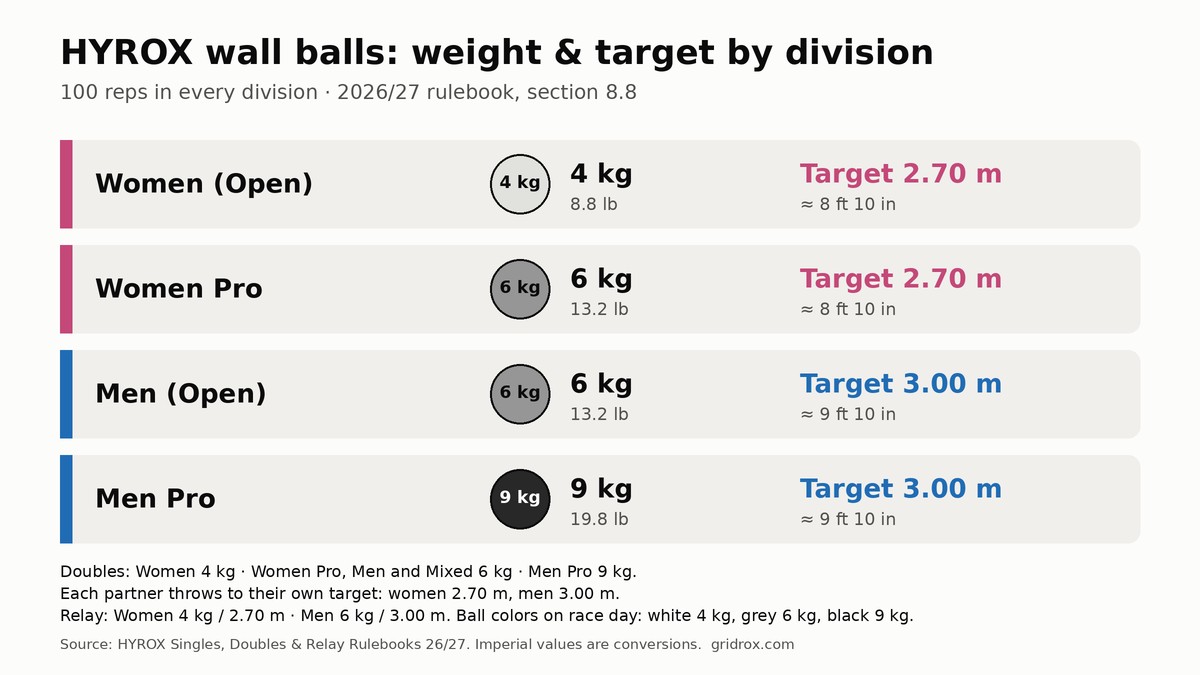
Every division does 100 reps. What changes is the ball and the target:
| Division | Ball weight | Target height |
|---|---|---|
| Women (Open) | 4 kg (8.8 lb) — white ball | 2.70 m (≈ 8 ft 10 in) |
| Women Pro | 6 kg (13.2 lb) — grey ball | 2.70 m (≈ 8 ft 10 in) |
| Men (Open) | 6 kg (13.2 lb) — grey ball | 3.00 m (≈ 9 ft 10 in) |
| Men Pro | 9 kg (19.8 lb) — black ball | 3.00 m (≈ 9 ft 10 in) |
Source: HYROX Singles Rulebook 26/27, section 8.8. Pound and feet values are our conversions; the rulebook uses kilograms and meters.
Two details people often get wrong about HYROX wall ball weight and height:
- Women Pro throw a heavier ball, not a higher target. They use the 6 kg ball but still throw to the women’s 2.70 m target.
- The targets aren’t the 9 ft / 10 ft many gyms use. HYROX targets are 2.70 m and 3.00 m — each a couple of inches below 9 ft and 10 ft. Training to a 10 ft target as a man is fine (slightly harder); training women to 10 ft overshoots the race standard.
Doubles and Relay
| Division | Ball weight | Target height |
|---|---|---|
| Doubles Women | 4 kg | 2.70 m |
| Doubles Women Pro, Doubles Men, Doubles Mixed | 6 kg | Women 2.70 m · Men 3.00 m |
| Doubles Men Pro | 9 kg | 3.00 m |
| Relay — Women | 4 kg | 2.70 m |
| Relay — Men | 6 kg | 3.00 m |
In Doubles the 100 reps are shared, and each partner throws to their own target, so in Mixed Doubles the woman throws the 6 kg ball to 2.70 m and the man to 3.00 m. The full load table for every station is in our HYROX weights guide.
How Many Wall Balls in HYROX?
100 valid reps, in every division — Open, Pro, Doubles and Relay. “Valid” is the key word: no-reps don’t count toward the 100, and leaving the station before you’ve completed 100 valid reps is a disqualification. Where digital target screens are used they show your count and flag no-reps, but they’re only a visual aid — the physical target and the judge are the official standard.
What Counts as a Rep (and What’s a No-Rep)
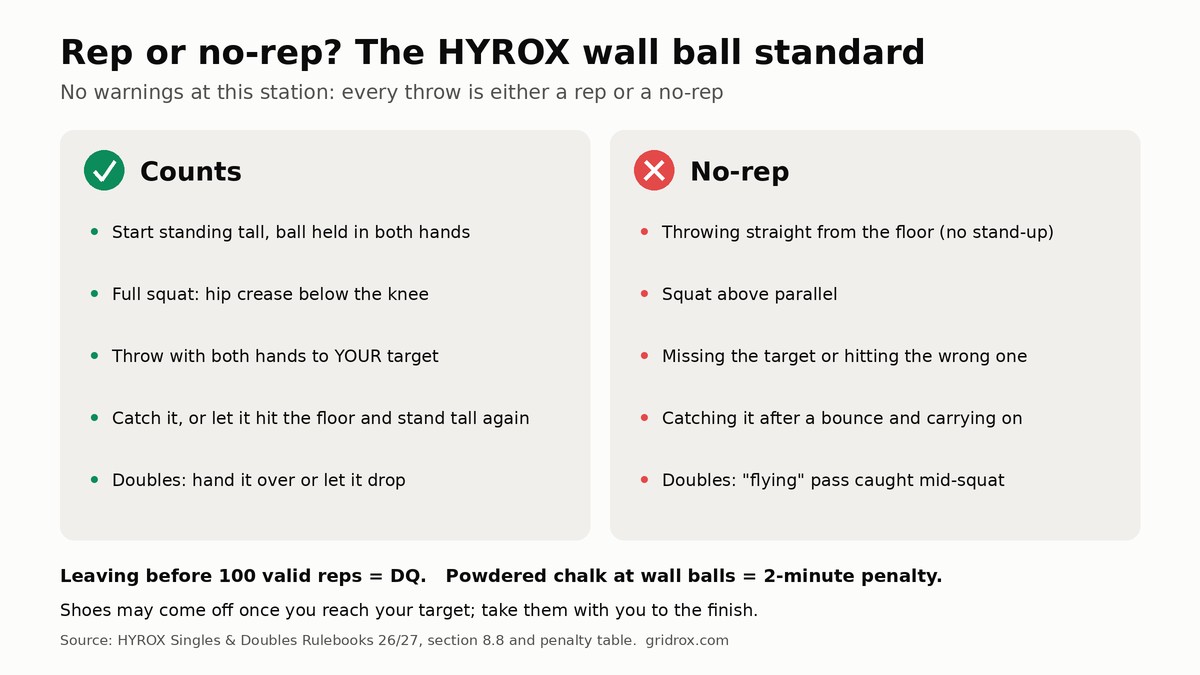
From section 8.8 of the rulebook, a valid rep looks like this:
- Start standing tall — hips and knees extended, ball held with both hands. You can’t scoop the ball off the floor and throw it straight away.
- Full squat: at the bottom, your hips must go lower than your knees (below parallel). A judge may use a squat depth box to check, but it’s not for sitting on.
- Throw with both hands so the ball strikes your designated target in the strike zone.
- Catch it and go again, or let it hit the floor and stand tall before the next rep. You can’t catch it after a bounce and keep going.
At this station there are no warnings — every throw is either a rep or a no-rep. Two more rules to know: using powdered chalk at wall balls is a 2-minute penalty, and you may take your shoes off once you reach your target, as long as you put them under the rig and carry them to the finish. (Gear questions? See what you can wear in HYROX.)
In Doubles, the resting partner stays in the marked area under the rig, and the ball changes hands either by passing it or by letting it drop. A “flying” handover — one partner throws, the other catches it mid-squat and keeps going — is a no-rep.
HYROX Wall Ball Height: Why the Target Matters
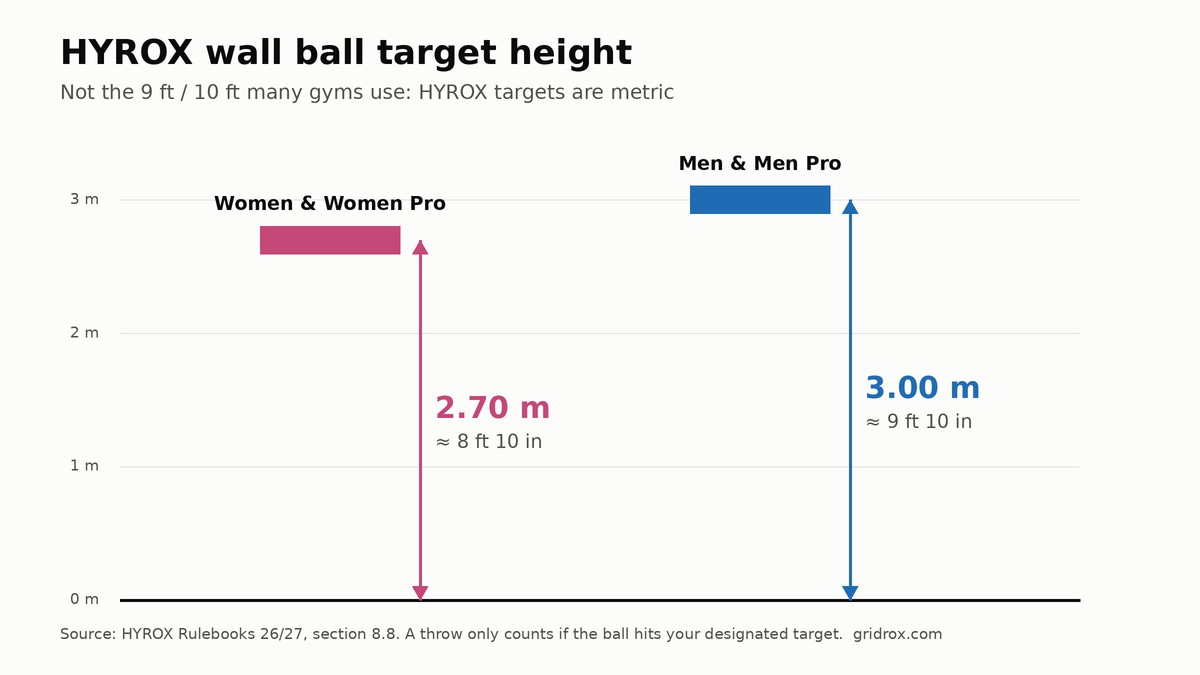
Most no-reps late in a race come from two things: a squat that gets shallower as you tire, and throws that fall short of the target. Because the target is fixed at 2.70 m or 3.00 m, a tired throw that lands just under the line doesn’t count — and you’ve spent the energy anyway. Train to the exact height you’ll face (or slightly above).
Technique: Make Every Throw Count
- Dip and drive. Sit down into the squat with your chest up, then drive out of the bottom with your hips and legs. The ball should feel like it’s launched by your legs, with your arms just guiding it.
- Use your hips, not your shoulders. Shoulders fatigue fast after the SkiErg, rowing and the sled pull. A strong hip extension carries the ball to the target with less arm work.
- Catch high, absorb low. Catch the ball at face height with elbows soft and let the catch flow straight into the next squat. Fighting the ball to a dead stop wastes energy.
- Stand close. About an arm’s length from the wall keeps the ball path vertical and short.
- Breathe on a rhythm. One breath per rep (exhale on the throw) keeps your sets steady.
- Break it up early. Plan sets before you need them, such as 10 × 10 or 20-15-15-10…, with short planned rests, instead of going unbroken and stalling at 40.
Wall Ball Time: How Long Should 100 Reps Take?
In our pace calculator‘s Open model, wall balls are the longest single station: around 9:57 for a 1:25 men’s finish and 11:05 for a 1:37 women’s finish. That’s more than 11% of the race on one station. See the full split tables in what is a good HYROX time, and print your targets on a race split pace band.
Training Progressions
- Build the base (weeks 1–4): 3–5 sets of 15–25 reps at race weight and target, with full squat depth on every rep. Film a set to check depth.
- Add volume (weeks 5–8): work up to 100–150 total reps in a session, in broken sets (e.g. 5 × 20 or 10 × 15), resting as little as you can while keeping every rep valid.
- Train them tired (weeks 9+): pair wall balls with lunges or a 1 km run, such as 1 km run + 50 wall balls, or 100 m lunges + 30 wall balls × 3. That’s the race-day reality.
- Race simulation: finish a full or half simulation with 100 wall balls and practise your planned set breakdown.
Our 12-week training plan builds these in, and the pacing guide covers how to arrive at station 8 with something left.
Racing Soon?
Next up on the US calendar is HYROX Tampa (October 22–25), then Denver, Dallas, Anaheim and Nashville. Dates and venues for every race are on the US race calendar.
Frequently Asked Questions
What is the HYROX wall ball weight?
4 kg for Women (Open), 6 kg for Women Pro and Men (Open), and 9 kg for Men Pro. In Doubles: 4 kg for Women, 6 kg for Women Pro, Men and Mixed, and 9 kg for Men Pro.
How high is the HYROX wall ball target?
2.70 m (about 8 ft 10 in) for women, including Women Pro, and 3.00 m (about 9 ft 10 in) for men, including Men Pro.
How many wall balls are in HYROX?
100 valid reps in every division. In Doubles and Relay the team shares the 100.
Can you drop the wall ball in HYROX?
Yes. You can let the ball hit the floor after it touches the target, but you must stand tall, holding it in both hands, before the next rep. Catching it after a bounce and continuing is a no-rep.
Can you use chalk at the wall balls?
No. Using powdered chalk at the wall ball station is a 2-minute penalty.
More from GridRox: HYROX weights guide · What can you wear in HYROX? · HYROX results explained · US race calendar
GridRox is independent of HYROX GmbH. Specs are from the official 2026/27 HYROX rulebooks (files dated September 14, 2026), checked October 15, 2026. Imperial conversions are ours.
