
Training
Sled Push & Pull: Race Weights, Distance & Technique
Oct
The HYROX sled push and HYROX sled pull are separate 50-meter stations. Both use four 12.5-meter lengths, but they demand different skills: maintaining leg drive on the push, then managing the rope and working space on the pull. Knowing the load is only the beginning.
The tables below use the official 2026/27 rulebooks, checked October 22, 2026. All stated weights include the sled itself. Technique suggestions later in the guide are practical coaching cues, separate from the rules that determine whether your work counts.
Sled push and pull weights by division
Your sled push weight and sled pull weight depend on the division you entered. Read each total as sled plus plates, not plates alone.
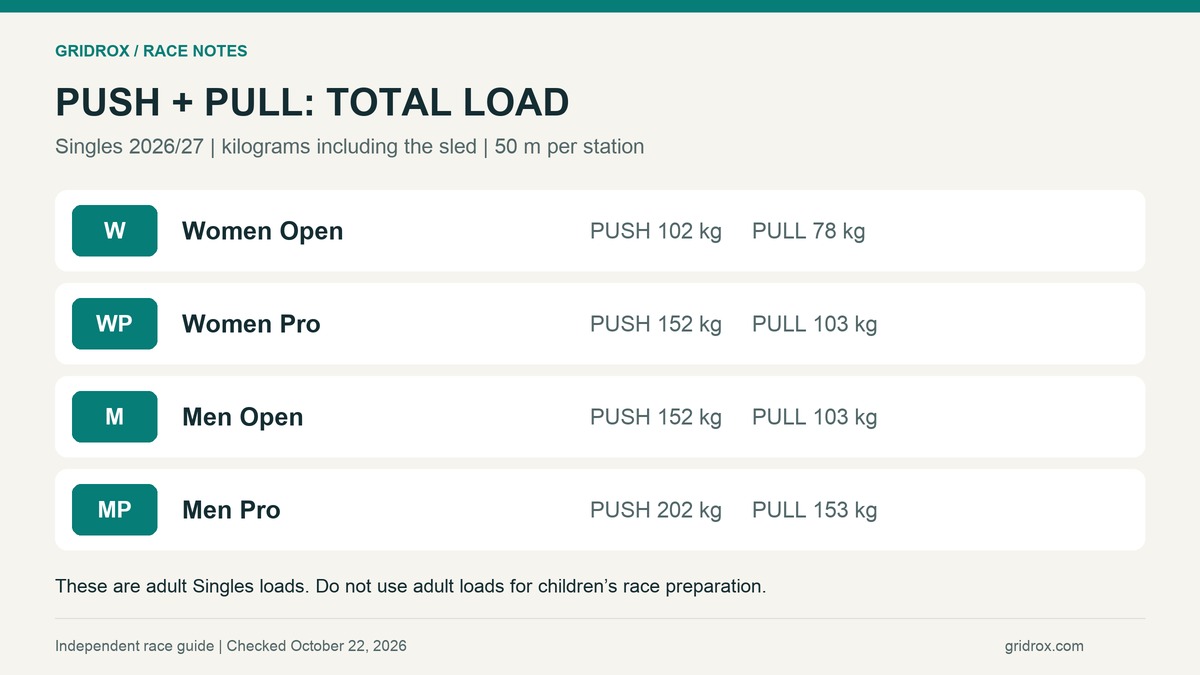
| Singles division | Push: total load | Pull: total load |
|---|---|---|
| Women Open | 102 kg / about 225 lb | 78 kg / about 172 lb |
| Women Pro | 152 kg / about 335 lb | 103 kg / about 227 lb |
| Men Open | 152 kg / about 335 lb | 103 kg / about 227 lb |
| Men Pro | 202 kg / about 445 lb | 153 kg / about 337 lb |
Source: Singles 26/27, sections 8.2–8.3. Pounds are rounded conversions; kilograms are the official values.
For Doubles, Women use the women’s Open loads; Women Pro, Men and Mixed use 152 kg for the push and 103 kg for the pull; Men Pro use 202 kg and 153 kg. The station distance is shared between the two partners rather than doubled. See our Doubles guide for the wider race format.
Relay is a different format again: the women’s sled loads are 102 kg push and 78 kg pull; men’s relay loads are 152 kg and 103 kg. Use the Relay guide and your official briefing to plan station allocation. These adult tables are not youth-race prescriptions.
Does the weight include the sled?
Yes. A 152 kg push is the total moving load, not 152 kg of plates plus an empty sled. In training, find the manufacturer’s empty-sled weight before deciding how many plates to add.
For example, if your gym’s sled weighs 40 kg and you want a nominal 152 kg total, the arithmetic is 112 kg of added load. That is a calculation example, not a claim about the weight of the race equipment. Different sled models have different empty weights.
Two sleds with the same total mass can also feel very different because of turf, friction, sled design and surface condition. Record the total load and the training surface together. Treat another gym’s plate stack as context, not a precise prediction of how fast you will move on race day. Our complete race weights guide covers the remaining stations.
Distance: four complete lengths, not four turns
The adult sled push distance is 50 meters, and the sled pull covers the same total distance at its own station.
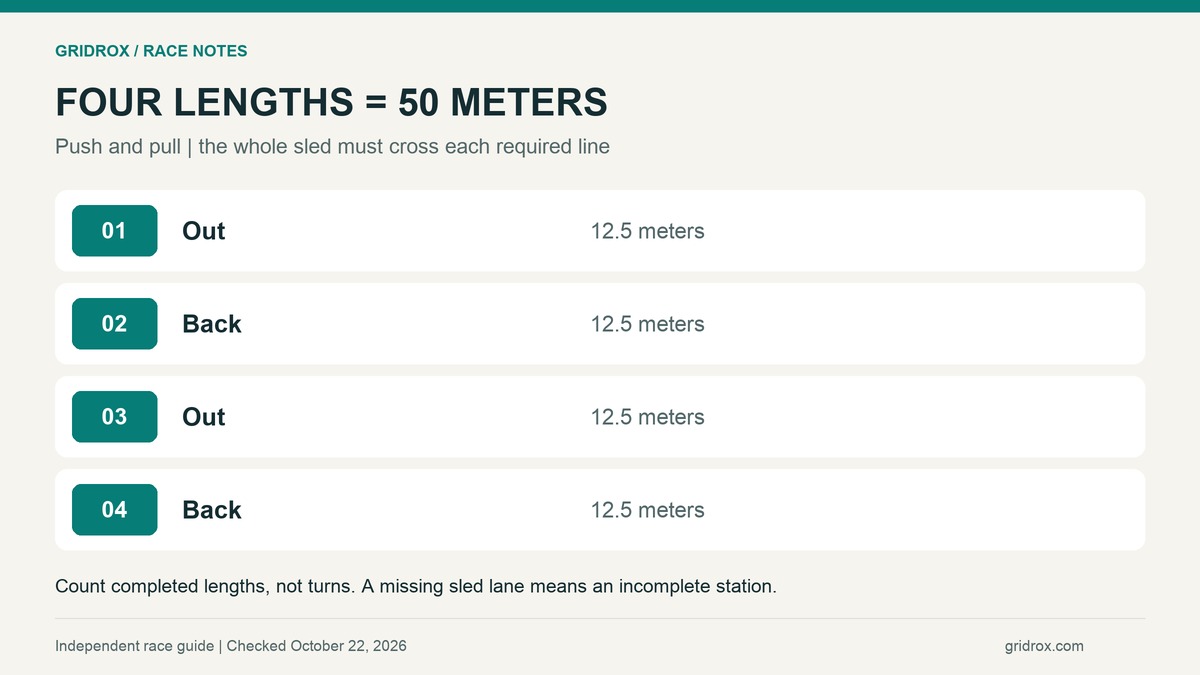
Each sled station totals 4 × 12.5 m = 50 m. Count completed lengths: out, back, out, back. Do not count a turn as an additional length. At the end of each length, the entire sled must clear the required line before you change direction or consider the station finished.
Use the lane assigned by the judging team and remain clear of neighboring racers. The 2026/27 penalty table lists a missing sled lane as an incomplete station and therefore disqualification. Older advice about simply accepting a three-minute penalty for a missing sled length should not be used for this season.
Push rules and useful technique cues
The official push rules require the racer and sled to start behind the white line, stay within the assigned lane and complete each full length. Movement infringements use a warning followed by 15-second penalties for further infringements under the station protocol. Completing the whole station remains mandatory.
For technique, test a position that lets you apply force without repeatedly losing your footing. A lower body angle and short, deliberate steps can help keep the sled moving, but the best hand and arm position depends on your height, strength and the equipment.
- Set your feet before driving. Start with stable traction rather than rushing into a slipping first step.
- Keep the steps controlled. Long reaching strides can interrupt pressure on the sled.
- Breathe during the effort. Avoid turning an entire length into one prolonged breath hold.
- Choose breaks deliberately. If continuous movement is not sustainable, use a short planned pause and restart with control.
- Finish the line. Check the whole sled is across before turning around.
Do not spend all your energy chasing someone else’s station split. A push that leaves you walking the next run may cost more time than it saves. Practice the transition back to running as part of your pacing work.
Pull rules: protect the box and manage the rope
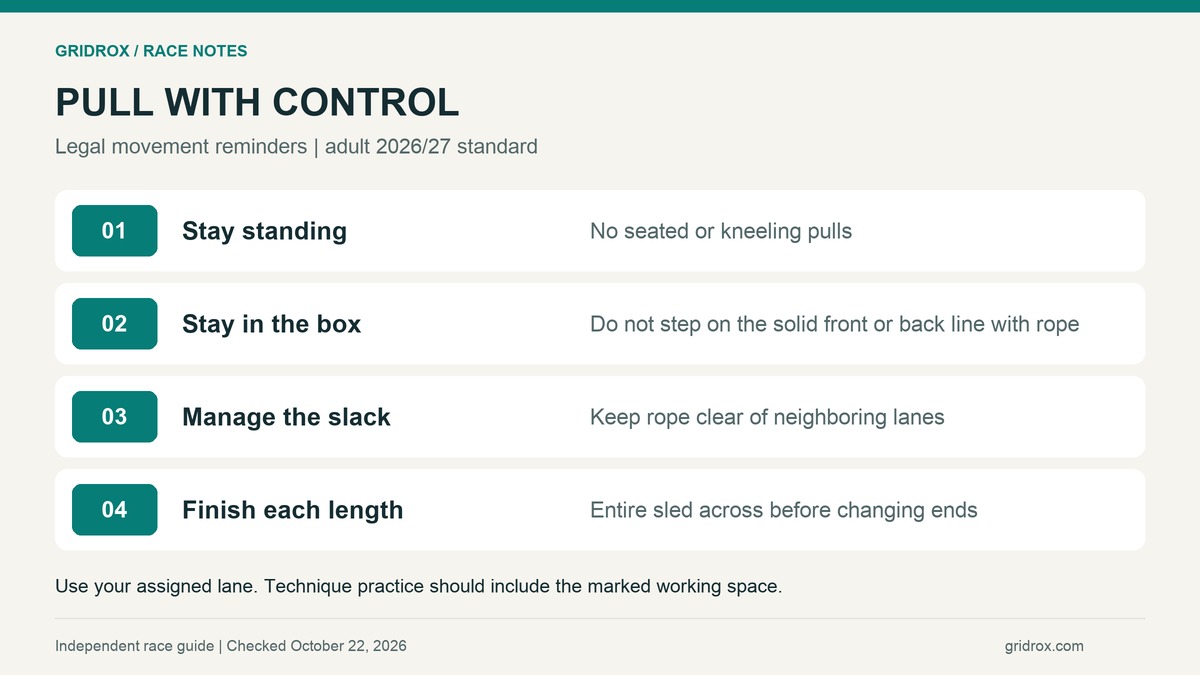
On the pull, both racer and sled must begin within their respective marked boxes. Stay standing throughout: seated and kneeling pulls are not permitted. Remain inside your working box and do not step on the solid front or back boundary while holding the rope.
Keep the rope in your lane without interfering with a neighboring lane. It may extend behind your lane, but it must not obstruct another racer. Once the entire sled crosses the far line, move to the opposite end for the next pull. The same warning-then-15-second movement penalty structure applies; a missing full length is an incomplete-station issue.
A practical pull sequence is to take tension in the rope, brace, pull smoothly and gather slack where you can see it. If you use backward steps, stay aware of the back boundary. Avoid dropping loose rope directly under your feet or letting it spill sideways into another lane.
Practice resetting before you run out of space. Repeatedly reaching the edge of the box and improvising is harder to manage when tired than a repeatable sequence of pulls and short resets.
For training kit, our half-finger training gloves and calf sleeves are optional comfort items, not ways to change the required load or distance. Read the race clothing and equipment rules before choosing what to use in competition; training use does not establish that an item is permitted at your event.
A training session that tests the right things
Begin with an easy warm-up and a few light practice lengths. Then choose a manageable load and rehearse complete lengths, line crossings and the turn. For the pull, mark a working box so the rope routine includes the spatial restriction.
When the movement is consistent, add short running segments before or after a sled effort. Keep the purpose narrow: find out whether you can resume controlled running, not whether you can exhaust yourself in one session. Increase load or volume gradually and leave demanding practice away from race day.
Record the load including the sled, surface, length, breaks and the quality of the run afterward. These notes provide a more useful progression than comparing a single best sled time on different turf. For overall pacing, use the race pace calculator.
Common questions
Are push and pull the same weight?
No. The push is heavier in every listed division. For example, Men Open use 152 kg on the push and 103 kg on the pull, both including the sled.
Can I sit down to pull?
No. The current pull standard requires you to remain standing.
Can I leave once the front of the sled crosses the line?
No. The whole sled must pass the required line. Count four complete lengths before leaving the station.
Can I trade a missing sled length for a time penalty?
The 2026/27 penalty table lists a missing sled lane as disqualification for an incomplete station. Complete the work and follow the judge’s instructions.
Independent GridRox guide. Sources: official Singles, Doubles and Relay 26/27 rulebooks, checked October 22, 2026. See also our race penalties guide.
